High Press: 5 Tactical Drills for Immediate Defensive Impact
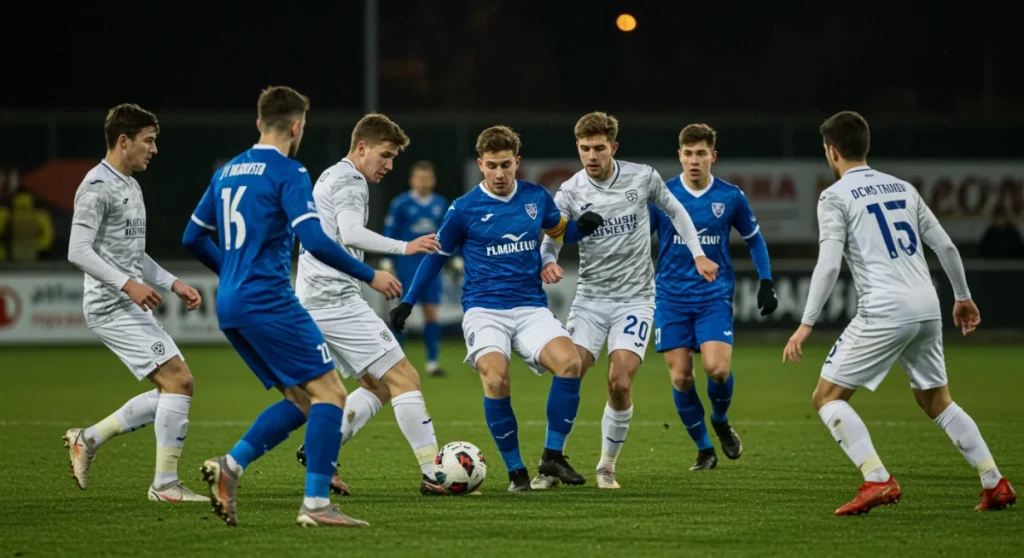
Implementing a high press can immediately enhance a soccer team’s defensive capabilities by disrupting opponent build-up and creating scoring opportunities through quick ball recovery in advanced areas.
In modern soccer, mastering the art of the high press: 5 tactical drills to implement for immediate defensive impact in the current season (practical solutions) is not merely a strategy; it’s a philosophy that defines successful teams. This aggressive approach aims to win the ball back high up the pitch, suffocating opponents and creating rapid transitions to attack. For any coach looking to instill a proactive defensive mindset and yield immediate results, understanding and effectively implementing the high press is paramount. Let’s delve into the core principles and practical drills that can transform your team’s defensive prowess.
Understanding the High Press Philosophy
The high press is more than just chasing the ball; it’s a meticulously coordinated effort involving the entire team. It demands exceptional physical conditioning, tactical intelligence, and unwavering commitment from every player. The primary goal is to deny the opponent time and space in their own half, forcing errors and turnovers in dangerous areas.
A successful high press relies on several key components: trigger movements, coordinated pressure, cover shadows, and quick transitions. Without a clear understanding of these elements, a press can easily be bypassed, leaving a team vulnerable. It requires significant training time and repetition to become second nature for players.
Key Principles of Effective Pressing
Effective pressing is built on collective understanding and individual responsibility. Players must know when to press, whom to press, and where their teammates will be. This collective intelligence is what transforms individual effort into a cohesive, game-changing strategy.
- Trigger Movements: Identifying the cues that initiate the press, such as a backward pass, a poor touch, or a specific body orientation of an opponent.
- Coordinated Pressure: Multiple players converging on the ball carrier and nearby passing options simultaneously, rather than isolated individual efforts.
- Cover Shadows: Positioning players to block passing lanes to potential receivers, effectively limiting the opponent’s options.
- Numerical Superiority: Creating an overload in the pressing area to maximize ball recovery chances.
Ultimately, the high press is about control. It dictates the tempo of the game, frustrates opponents, and provides a direct pathway to goal-scoring opportunities. It’s a demanding but rewarding tactical approach that can elevate any team’s performance almost immediately.
Drill 1: The ‘Trigger Press’ Grid
This foundational drill helps players recognize pressing triggers and execute a coordinated initial press. It focuses on the immediate reaction to specific opponent actions, teaching players to hunt the ball in unison.
Set up a 20×20 yard grid with two small goals on opposite sides. Divide players into two teams of 4-5. One team starts with possession, aiming to pass the ball through one of the small goals to score. The defending team aims to win possession and then score. The drill emphasizes quick transitions and identifying the moment to press.
Execution and Focus Points
The coach introduces a specific trigger, such as a backward pass or a player receiving the ball with their back to goal. When this trigger occurs, the defending team must immediately initiate a collective press. The intensity and speed of the press are crucial for success.
- Communication: Players must communicate verbally to coordinate their movements and ensure no player is left isolated.
- Angle of Approach: Defenders should approach the ball carrier from angles that funnel them into confined spaces or towards the touchline.
- Body Shape: Players pressing should adopt a body shape that allows them to quickly change direction and prevent forward passes.
- Follow-up Pressure: The press doesn’t end with the initial defender; teammates must provide immediate support and cover.
This drill is excellent for developing the instinctual reactions required for a successful high press. It teaches players to read the game and respond as a unit, laying the groundwork for more complex pressing schemes.
Drill 2: ‘Pressing Lanes’ Rondo
This drill refines the concept of cover shadows and denying passing lanes, a critical element of an effective high press. It helps players understand how to position themselves to block options while still providing pressure.
Organize a 15×15 yard rondo with a 4v2 or 5v2 setup. The four or five players in possession try to keep the ball, while the two defenders aim to win it back. The key difference here is the emphasis on the defenders’ positioning to cut off passing lanes, not just chase the ball.
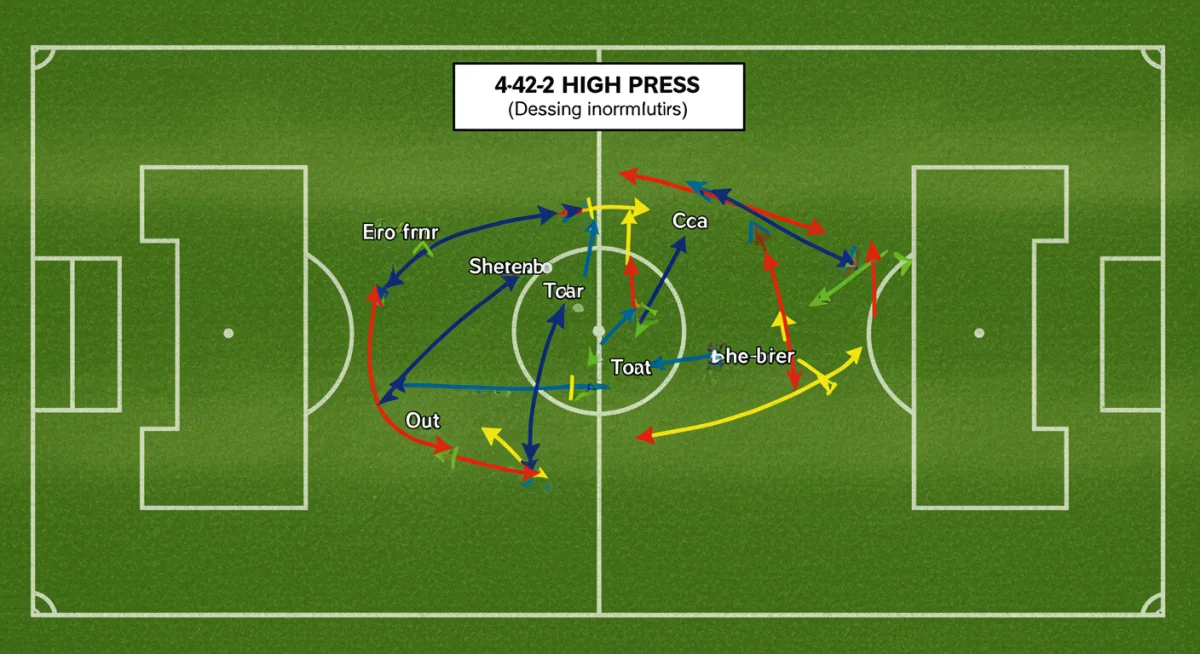

Tactical Nuances in Pressing Lanes
The defenders are instructed to work together, with one applying pressure to the ball carrier and the other positioning themselves to intercept a potential pass. This creates a ‘pressing lane’ where the opponent’s options are severely limited. The focus is on intelligent positioning rather than brute force.
The pressure on the ball should be constant but controlled, preventing the ball carrier from having the time to pick out an incisive pass. The second defender’s role is to anticipate the next pass and adjust their position accordingly, effectively creating a ‘trap’ for the ball.
- Anticipation: Defenders must anticipate the opponent’s next move and react quickly to close down space.
- Body Orientation: Players should orient their bodies to simultaneously press the ball and block a passing lane.
- Compactness: The defending unit must remain compact, reducing the space available for the opponent to play through.
- Decision Making: Players learn when to engage the ball and when to hold their position to deny a pass.
This rondo variation is particularly effective for developing the tactical awareness needed to create defensive traps and force turnovers in critical areas of the pitch, making it an invaluable addition to high press tactical drills.
Drill 3: ‘Half-Field Overload’ Pressing Game
This drill simulates a more realistic game scenario, focusing on applying a high press in a specific area of the pitch, often the opponent’s half. It introduces numerical superiority in the pressing zone to overwhelm the opponent.
Set up half a regular soccer field. Divide players into two teams: an attacking team (e.g., 6 players) and a defending team (e.g., 8 players). The attacking team starts with the ball near their own goal, attempting to build up play and score on the full-sized goal. The defending team aims to press high, win the ball, and score quickly on a small counter-goal or by crossing a designated line.
Creating Numerical Superiority
The defending team starts with a numerical advantage in the opponent’s half, allowing them to effectively surround the ball and cut off multiple passing options. This drill emphasizes the importance of the entire team moving together as a unit, shifting and adjusting their positions based on the ball’s location.
The coach can introduce conditions, such as requiring the defending team to win the ball back within 5 seconds of the initial press. This encourages intensity and rapid decision-making, crucial for successful high pressing.
- Collective Movement: The entire defending unit must move in sync, maintaining a compact shape and pressing together.
- Aggression and Intensity: Players must demonstrate high levels of aggression and intensity to win the ball back quickly.
- Transition to Attack: Upon winning possession, the team must transition immediately into an attacking phase, capitalizing on the opponent’s disorganization.
- Recovery Runs: If the press is bypassed, players must make quick recovery runs to prevent the opponent from exploiting space.
The ‘Half-Field Overload’ drill is excellent for practicing the high press in a game-like environment, allowing players to experience the benefits of collective pressure and rapid transitions. It hones their ability to exploit numerical advantages effectively.
Drill 4: ‘Pressing Traps’ with Wide Players
This drill specifically targets how wide players (wingers, fullbacks) can be instrumental in setting pressing traps along the touchlines, using the sideline as an extra defender. It’s about funneling the opponent into predictable areas.
Create a narrow field, perhaps 30-40 yards wide and 40-50 yards long, with a central zone. Two wide players from the defending team are positioned on the touchlines, ready to close down. The attacking team tries to build up play from their defensive third, while the defending team aims to win the ball back by trapping the opponent in wide areas.
Utilizing the Touchline as a Defender
The focus here is on the coordinated movement of the wide player and an interior player to create a trap. When the ball goes wide, the winger presses the opponent, while a central midfielder or fullback cuts off the passing lane down the line or inside. This forces the opponent to either make a risky pass or lose possession.
The drill can be modified to include specific scenarios, such as a fullback receiving a pass under pressure, prompting the winger and nearest central midfielder to initiate the trap. This teaches players to react to specific situations with predetermined movements.
- Coordinated Trapping: Wide players and interior players must work together to close down space and create a numerical overload in wide areas.
- Speed of Closure: The quicker players close down the opponent in wide areas, the less time they have to react.
- Body Position: Players should position themselves to block attempts to play out of the trap, forcing turnovers.
- Anticipating Clearance: Defenders should anticipate a desperate clearance and be ready to win the second ball.
This drill highlights the crucial role of wide players in a high-pressing system, teaching them how to effectively use the touchline to their advantage and create turnovers in dangerous areas of the pitch.
Drill 5: ‘Full-Field Zonal Press’ Simulation
This advanced drill integrates all previous concepts into a full-field simulation, allowing the team to practice their high press in a highly realistic match context. It emphasizes zonal responsibilities and collective movement across the entire pitch.
Conduct an 11v11 or 10v10 full-field game. The coach instructs one team to consistently apply a high press whenever the opponent gains possession in their defensive third. The focus is on maintaining shape, pressing triggers, and the seamless transition between pressing and defending deeper if the press is bypassed.
Advanced Pressing Strategies
The ‘Full-Field Zonal Press’ requires high levels of fitness and tactical understanding. Players must understand their zonal responsibilities within the pressing scheme, knowing when to step out to press and when to hold their position to maintain defensive shape. The entire team must move as a single, cohesive unit.
The coach can pause the drill to highlight successful pressing sequences or areas where the press broke down, providing immediate feedback. This allows for real-time adjustments and reinforces the tactical principles.
- Maintaining Shape: The team must maintain its defensive shape even while pressing high, preventing large gaps from appearing.
- Stamina and Fitness: High-intensity pressing over a full game demands exceptional physical conditioning.
- Reading the Game: Players must be adept at reading opponent passes and movements to anticipate pressing opportunities.
- Adaptability: The ability to adjust the pressing intensity and strategy based on the opponent’s actions.
This full-field simulation is the ultimate test of a team’s high-pressing capabilities, bringing together all the elements learned in previous drills into a comprehensive, game-like scenario. It prepares players for the demands of applying a high press throughout an entire match.
Implementing and Refining Your High Press
Implementing a high press is an ongoing process that requires patience, consistent training, and tactical flexibility. It’s not a one-time fix but a continuous evolution, adapting to different opponents and game situations. The drills outlined above provide a structured pathway to developing a robust and effective pressing system.
Beyond the drills, regular video analysis of training sessions and matches is crucial. This allows players to visually understand their roles, identify areas for improvement, and see the positive impact of their collective efforts. Feedback should be constructive and focused on reinforcing the core principles of the high press.
Adaptability and Player Buy-in
Coaches must be prepared to adapt their pressing schemes based on the opponent’s strengths and weaknesses. A rigid approach can be easily exploited. Furthermore, securing player buy-in is paramount; players must believe in the effectiveness of the high press and be willing to put in the immense effort it demands.
- Regular Review: Periodically review the effectiveness of the pressing system and make adjustments as needed.
- Individual Feedback: Provide personalized feedback to players on their pressing technique and decision-making.
- Fitness Regimen: Ensure the team’s fitness levels are sufficient to sustain high-intensity pressing for an entire match.
- Psychological Preparedness: Cultivate a fearless and aggressive mindset within the team, essential for high-intensity pressing.
By consistently working on these aspects, teams can develop a high press that not only disrupts opponents but also becomes a powerful weapon in their tactical arsenal, leading to immediate defensive improvements and sustained success.
| Key Drill | Primary Focus |
|---|---|
| Trigger Press Grid | Recognizing triggers and coordinated initial pressure. |
| Pressing Lanes Rondo | Denying passing lanes and cover shadows. |
| Half-Field Overload | Applying high press with numerical superiority. |
| Pressing Traps Wide | Using wide players to create touchline traps. |
Frequently Asked Questions About the High Press
The primary objective of a high press is to win possession of the ball back in advanced areas of the field, close to the opponent’s goal. This disrupts their build-up play, forces errors, and creates immediate attacking opportunities with less distance to cover.
A high press contributes to defensive impact by preventing opponents from establishing rhythm and creating chances. By winning the ball high, the team reduces the number of times the opponent can attack their own goal, effectively turning defense into offense.
Implementing a high press demands exceptional physical conditioning, including high levels of aerobic and anaerobic fitness. Players need to be able to make repeated sprints, quick changes of direction, and sustain high intensity throughout a match.
While effective, a high press may need adjustments based on the opponent. Teams with exceptional long-passing abilities or very fast forwards might bypass a poorly executed press. Adaptability and scouting are crucial for sustained effectiveness.
Communication is absolutely vital for a successful high press. Players must constantly talk to each other to coordinate triggers, pressure, cover shadows, and defensive adjustments, ensuring the entire team moves and reacts as a cohesive unit.
Conclusion
The high press, when executed with precision and collective commitment, is a transformative tactical approach that can deliver immediate defensive impact and elevate a team’s overall performance. By integrating these five practical drills into your training regimen, coaches can systematically develop the physical, technical, and tactical attributes necessary for a dominant high-pressing team. It’s a strategy that demands hard work and intelligence, but the rewards—in terms of ball recovery, goal-scoring opportunities, and game control—are undeniably significant for any aspiring team in the current season.